
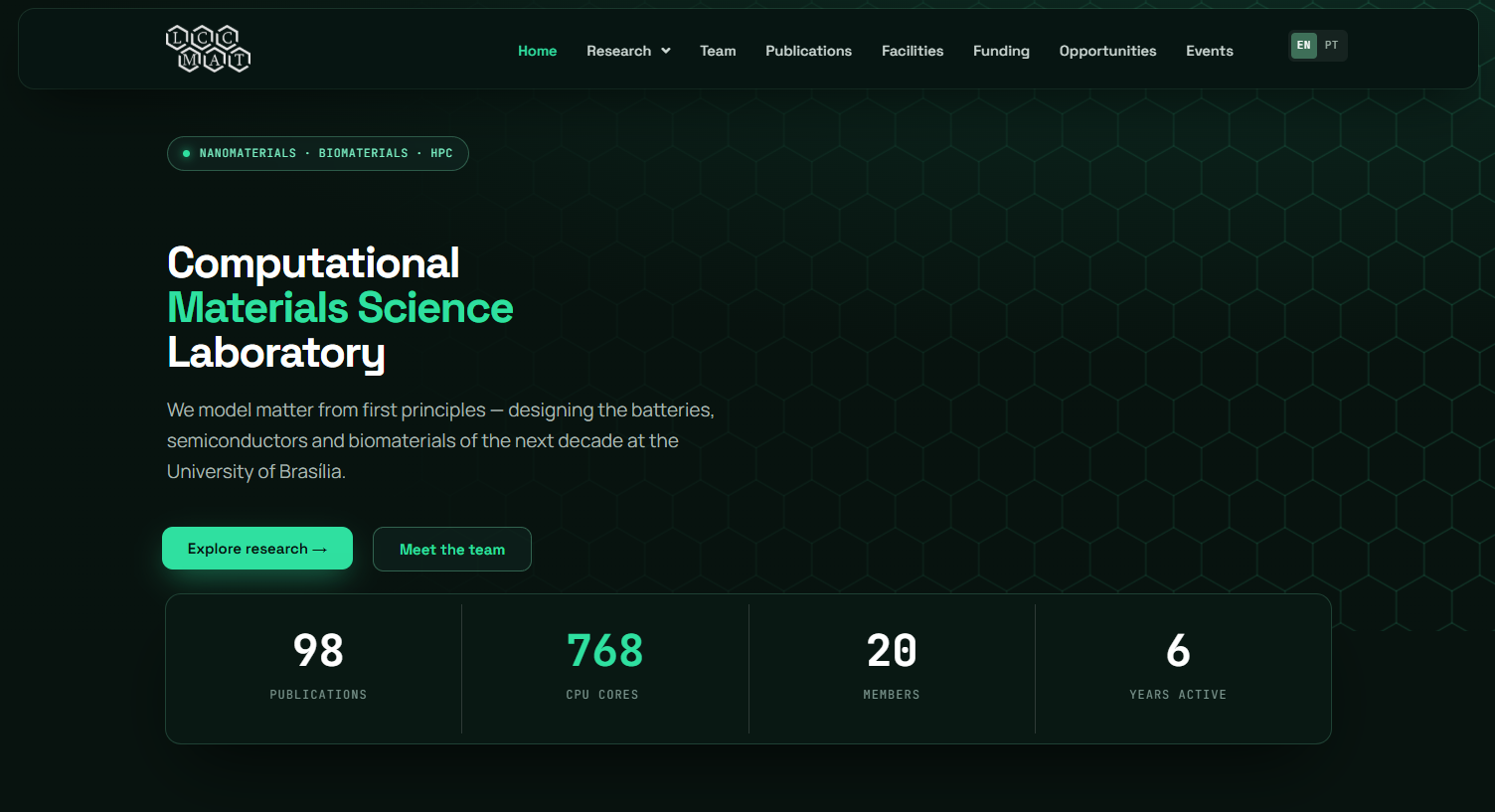
The new LCCMat home page. The honeycomb is the same motif that signs the header of every inner page.
The old site did its job for almost a decade, but it had one problem no content update could fix: visitors could not see the laboratory. Publications were a list, funding was a paragraph, and the computing infrastructure — the heart of LCCMat — read like a footnote.
The new home starts from a different premise: every page answers a concrete question an outsider would ask. Who funds this? What machines does it run on? Who are the people? How do I join? The design — technical type, petroleum-dark backgrounds, the honeycomb as a signature — exists to serve those answers, not to decorate them.
The group's output is now navigable by year, by research line and by collaboration, with external co-authors visible. You can read the lab's trajectory in a minute of scrolling.
See publications →The 17 projects that built the lab between 2016 and 2025, each with its call, process number and coordinator. Transparency that doubles as a map for anyone writing a proposal.
See funding →The multi-user platform described as it is: nodes, capacity, available software and how other groups can use it. It is the most direct invitation the lab has to make.
See facilities →The running selection up front, with its schedule and results; closed ones archived in collapsible entries, each with its PDF and the selected candidates. Nothing vanishes when a call ends.
See opportunities →The site has an English version, but the calls stay in Portuguese only — translating a binding document would misstate it. Instead, a page explains to international applicants how to read them.
How to apply from abroad →Technical typography, a petroleum-and-emerald palette, the honeycomb as a signature, and a closed set of components reused across every page. A new page joins without a redesign.
Space Grotesk · Manrope · JetBrains MonoThe applications our team builds
The part of the work that was least visible on the old site is the one that grew the most: software. Much of what LCCMat produces today is not only papers — it is tooling that runs on the cluster, solves a concrete problem, and stays for the next group to use. The new home gives it a section.
Machine-learning models trained on well-core images and tomographies of carbonate rocks, with a focus on pore identification. The pipeline runs from curating the image database to an analysis code tuned for high-performance computing.
The lab's newest front: simulating gas-separation membranes as digital twins and validating the results experimentally, with industrial prototyping as the stated target.
The set of routines the lab maintains to build systems, run classical and reactive molecular dynamics, and extract structural, thermodynamic and transport properties — the same toolkit behind much of the group's published work.
If you maintain code, a pipeline or a tool in the lab and want it listed here — with a name, a repository and one line on what it solves — send it to the group's address.
What comes next
Moving house is not finished today. The next fronts are already on the table: individual pages for each application, with repository and usage notes; the internal and external events sections reorganised; and the alumni record treated with the same care as the publications.
If something looks wrong, out of date or missing — and on a site this size it will — the shortest path is to write to lccmat@unb.br. Fixing is quick; finding out is the hard part.
Want to use the cluster, or join the group?
The platform is multi-user, and fellowship calls are published on the site. Start from one of these two pages.