Our research lines are centered on the advanced computational modeling of novel materials, utilizing Density Functional Theory (DFT) and Molecular Dynamics (MD) to investigate a wide array of nanoscale and solid-state systems. We focus on understanding the fundamental structural, electronic, and transport properties of these materials to drive innovation in high-performance applications, such as energy storage, gas selectivity, and optoelectronics. By bridging rigorous theoretical methodologies with practical technological challenges, our diverse projects aim to accelerate the rational design of next-generation devices.
Antiperovskites: Structure and Electronics via DFT
Focused on antiperovskites (oxides, nitrides, and halides), this research line seeks to elucidate the relationships between crystal structure, stability, and ionic/electronic transport properties, aiming for applications in solid electrolytes, sensors, and energy conversion.
The investigation includes the calculation of potential energy surfaces for ionic migration (vacancies/interstitials), elasticity and mechanical response, electronic properties (band structure/PDOS), and vibrational stability via phonons, in addition to the effects of doping, pressure, and temperature.
The results guide the selection of compositions with low migration barriers, suitable electrochemical windows, and mechanical robustness.
Main computational tools:
- VASP (DFT);
- and Quantum ESPRESSO (DFT);
- PHONOPY (phonons).
Gas Selectivity and Transport in Zeolites via MD and DFT
This line combines DFT and MD to study the adsorption and selective transport of molecules (e.g., $CO_{2}/CH_{4}/N_{2}/H_{2}O$) in microporous zeolite frameworks, with an emphasis on CHA-group structures (and related ones).
The work addresses the localization of active sites, the effect of heteroatom/cation distribution, multicomponent competition, diffusion in narrow channels, and stability in the presence of moisture.
Adsorption energies, free energy profiles, and diffusion coefficients are estimated to substantiate the prediction of selectivity and permeability, guiding the design of separation and capture processes with lower energy costs.
Main computational tools:
- SIESTA/VASP (DFT);
- LAMMPS (MD);
- and Python analysis routines;
- when applicable, GCMC simulations complement the obtainment of isotherms.
Electrode Materials for Lithium-Ion Batteries via DFT
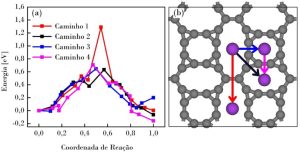
The objective of this line is to evaluate, through DFT, novel anode and cathode materials, elucidate Li insertion/extraction pathways, and anticipate performance metrics relevant to high-energy-density batteries.
The investigation covers adsorption and intercalation energies, open-circuit voltages, ionic migration barriers (via NEB), structural stability (including under volumetric variation), and mechanical integrity, alongside the role of defects and doping in electronic/ionic conductivity.
The approach prioritizes the correlation between atomic structure, thermodynamics, and transport, supporting the screening of compositions with higher specific capacity and operational safety.
Main computational tools:
- VASP and SIESTA (DFT);
- PHONOPY (vibrational stability);
- NEB/CI-NEB (diffusion);
- and VASPKIT/ASE (analysis).
Molecular Dynamics of Supercapacitors and Electrochemical Interfaces
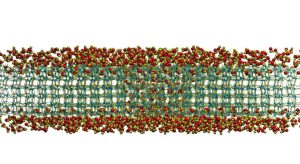
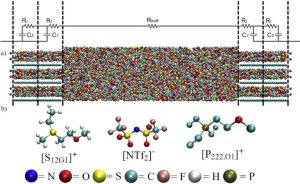
This line is dedicated to understanding, via classical Molecular Dynamics, the mechanisms of electrostatic storage in supercapacitors, focusing on the formation of the electrical double layer at carbon-electrolyte interfaces.
The work investigates the impact of electrode texture (microporosity/mesoporosity), electrolyte composition (aqueous, organic, water-in-salt, ionic liquids), and temperature on ionic structure, diffusivity, adsorption kinetics, and dynamic response.
Constant charge and constant potential methodologies are employed to approximate real operating conditions and extract metrics such as differential capacitance, charge transfer resistance, and cycling stability—direct inputs for optimizing device performance and lifespan.
Main computational tools:
- LAMMPS (MD);
- PACKMOL (structural preparation);
- and OVITO/Python (analysis).
Ab Initio Modeling of MXenes for Energy Conversion
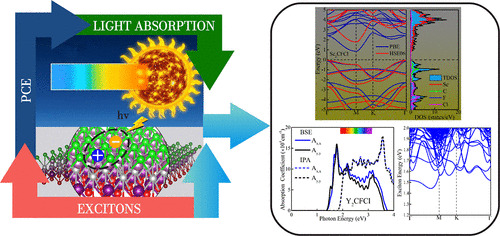
This line investigates two-dimensional MXenes (and their surface functionalizations) as platforms for energy conversion and electrochemical catalysis, targeting processes such as $CO_{2}$ reduction, $H_{2}$ evolution/oxidation, and redox reactions in devices.
The study encompasses thermodynamic and dynamic stability, electronic properties, work function, active sites, and the effects of defects, doping, and mechanical strain on the adsorption energy of reaction intermediates.
The emphasis is on identifying descriptors (e.g., adsorption $\Delta G$) that correlate structure and performance, enabling the rational design of more efficient and durable materials under operational conditions.
Main computational tools:
- VASP, SIESTA, and Quantum ESPRESSO (DFT);
- supported by PHONOPY (phonons);
- and VASPKIT/ASE (post-processing).
Modeling and Simulation of Optoelectronic Processes in Organic Semiconductors
Through quantum chemistry and computational physics methods, this project proposes the computational modeling of various organic systems to be used as active layers in optoelectronic devices, especially in photovoltaic systems.
The primary object of study is the investigation of charge carrier transfer, separation, and recombination processes in organic heterojunctions—systems that can be applied in the development of solar cells (photovoltaic devices).
A significant portion of this project is dedicated to the development of new methodologies capable of rendering simulation conditions more realistic and results more accurate, thus encompassing a methodological bias.
The development of these novel methodologies can provide a more detailed and precise description of the electronic structure of various organic systems at both atomic and molecular scales, contributing to a better understanding of the physical processes involved in the operation of optoelectronic devices, as well as to the development of new materials—which is highly attractive from both academic and industrial standpoints.
Molecular dynamics calculations will be employed to study organic heterojunctions in candidates for high-performance photovoltaic systems.
By combining molecular dynamics and quantum mechanics calculations, it will be possible to propose a more realistic description of charge transport, transfer, separation, and recombination problems in several classes of organic conductors.
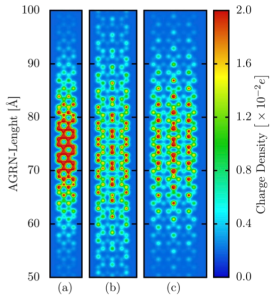
Additionally, among the studied problems, excited-state dynamics stands out, such as polaron transport in conjugated polymers and graphene nanoribbons.
The problem of excited-state dynamics in organic systems is investigated within the scope of Tight-Binding models with one- and two-dimensional relaxation.
Related publications:
- CARBON,132, 352-358, 2018.
- CARBON, 91, 171-177, 2015.
- Journal of Physical Chemistry Letters, 6, 510-514, 2015.
- Journal of Physical Chemistry Letters, 20, 3039-3042, 2012.
- Journal of Materials Chemistry C, 7, 4066-4071, 2019.
Use of Reactive Molecular Dynamics for the Study of Physicochemical Properties of Novel Nanostructures
This line is dedicated to studying the physicochemical properties of nanostructures based on novel carbon allotropes, aiming to propose more efficient materials regarding energy conversion and storage applications.
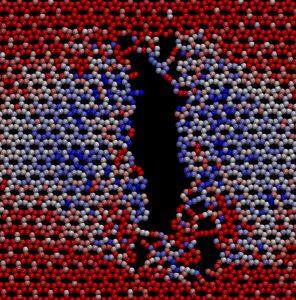
Among the studied problems, the structural and mechanical properties, fracture patterns, and degradation in gaseous atmospheres of these systems in monolayer, tube, and scroll forms stand out.
A considerable part of this project is dedicated to the development of new methodologies based on reactive molecular dynamics, capable of making simulation conditions more realistic and results more accurate for a robust description of the experimental data provided in the literature.
Molecular dynamics, utilizing a reactive potential, allows for the study of the dissociation and formation of chemical bonds in nanostructured systems.
The development of these new molecular dynamics-based methodologies can provide elements for a more detailed and precise description of the electronic structure of these systems at both atomic and molecular scales, contributing to a better understanding of the physicochemical processes involved in the operation of optoelectronic devices and to the development of new materials, which is highly attractive from academic and industrial perspectives.
Related publications:
- ChemPhysChem, “Just Accepted”, 2021
- Physical Chemistry Chemical Physics, “Just Accepted”, 2021
- J. Phys. Chem. C 2020, 124, 27
- Chemical Physics Letters, 756, 2020, 137830
- ChemPhysChem 2020, 21, 1918
- FlatChem 24, 2020, 100196
Main computational tools:
- LAMMPS (ReaxFF, AIREBO, Tersoff, and Stillinger-Weber (SW) potentials);
- and Materials Studio (GULP Module).
Use of Density Functional Theory for the Study of the Electronic Structure of Nanomaterials
In this research line, we study the electronic structure of nanomaterials that have been employed in the development of optoelectronic devices.
The investigation of the optical, structural, and electronic properties of monolayers and bilayers (also in the form of heterostructures) composed of transition metal dichalcogenides (TMDs), graphene and its allotropes, perovskites, and group III nitrides is the primary focus of the project.
A significant portion of this project is devoted to the design of novel materials—seeking a realistic and detailed description of the electronic structure of these new systems—that promote an increase in the operational efficiency of optoelectronic devices of great academic and industrial interest, such as thin-film transistors, light-emitting diodes, and photovoltaic cells.
Related publications:
- Physica E: Low-dimensinal Systems ans Nanostrucutres, 130, 114683, 2021
- Chemical Physics Letters, 771, 138495, 2021
- Electronic Structure, 3, 024005, 2021
- Physical Chemistry Chemical Physics, 23, 18807-10813, 2021
- Computational Materials Science, 183, 109860, 2020
- Physical Chemistry Chemical Physics, 21, 11168-11174, 2019
Main computational tools:
- SIESTA;
- QUANTUM ESPRESSO;
- and Materials Studio (CASTEP and DMol3 Modules).